
series by Abel B. Daartey
Patience sounds simple until you enter graduate school.
Before starting a PhD, I thought patience meant waiting calmly for something to happen. Waiting for an email. Waiting for a response. Waiting for an opportunity. I understood patience as delay, but I didn’t yet understand it as training.
A PhD changes that.
In research, patience is not passive. It is active. It is waking up, doing the work again, thinking again, reading again, troubleshooting again, and still believing that the process has something to teach you. It is not just waiting for results. It is learning how to survive the waiting without becoming careless or bitter.
There are experiments that make you question your planning. There are papers that make you feel like you do not know enough. There are meetings where you leave with more corrections than confidence. There are days when your progress feels invisible, even to yourself.
One experience that taught me this clearly was my shRNA knockdown experiment. I was working on knocking down one of my target genes, and I started by transfecting cells to produce the viral particles I needed for transduction. In the lab, we sometimes casually call the collected supernatant the “soup,” because that is the liquid that contains the viral particles you later use to transduce your target cells.
At first, everything looked promising. After the transfection, I could see green fluorescence under the microscope, which suggested that the delivery step had worked. That gave me some confidence. I thought, okay, at least this part is moving in the right direction.
Then came the puromycin selection.
I spent weeks selecting the cells, but somewhere in the middle of the process, I realized that I also needed to properly optimize the puromycin kill curve using parental cells. What I thought would be a straightforward experiment began stretching longer than I expected. I kept going, hoping that the selection would work and that the knockdown would eventually show clearly.
By the time I ran my Western blot and checked gene expression, I had already spent close to nine weeks on that experiment. And after all that time, the result was not what I wanted. The knockdown was not successful.
That kind of failure hurts because it isn’t just one bad day. It is weeks of planning, feeding cells, checking fluorescence, adding selection, waiting, hoping, and telling yourself that maybe the next step will finally confirm that everything worked. Then the data comes back and reminds you that effort alone does not guarantee success.
At that point, I set that attempt aside. My mentor even told me I did not need to repeat it. But something in me still wanted to try one more time, not because I was trying to be stubborn for no reason, but because I wanted to validate my own method and technique. I needed to know whether the experiment had failed because the approach was wrong or because I hadn’t done the method properly.
So I restarted the shRNA knockdown.
This time, I slowed down. I read the protocol myself instead of just copying what others in the lab had done. I paid closer attention to the details that were specific to my own experiment. I changed one or two conditions, followed the method more strictly, and stopped assuming that an established lab routine would automatically work for my exact target and system.
And this time, it worked.
That experience taught me something important about patience in research. Sometimes a technique fails not because you are incapable, but because you have not yet understood the small details that make the method work in your own hands. Established lab protocols are helpful, but they are not a substitute for understanding the technique yourself. You cannot just copy blindly and expect every biological system to behave the same way.
At first, I wanted the PhD to move at the speed of my effort. If I worked hard, I expected things to work. If I prepared well, I expected the outcome to reflect that preparation. If I gave something my full attention, I expected progress to show up quickly.
But science does not always respect that kind of timeline.
Cells grow when they grow. Assays work when the conditions are right. Data becomes meaningful only after enough careful thinking. A hypothesis may take months to sharpen. A project may require you to return to the same question again and again until you finally see what you missed the first time.
That has been one of my hardest lessons.
The cowboy-in-training side of me likes movement. It likes action. It likes to push forward, even when the road is rough. But PhD training has taught me that not every problem can be solved by pushing harder. Sometimes the wiser thing is to slow down, observe carefully, and admit that the system is more complicated than your confidence.
Patience in science is not weakness.
It is discipline.
It is the discipline to repeat a basic step properly, even when you are tired of doing it. It is the discipline to read the methods section carefully instead of assuming you already understand the experiment. It is the discipline to sit with confusing data long enough to separate what you hoped to see from what is actually there.
That is one of the frustrating but valuable parts of becoming a scientist. The experiment can humble you, but if you are willing to slow down and learn from the failure, it can also train you.
Patience is not the opposite of ambition. It is what allows ambition to survive long enough to become useful.
So if grit helped me enter the journey, patience is teaching me how to stay in it.
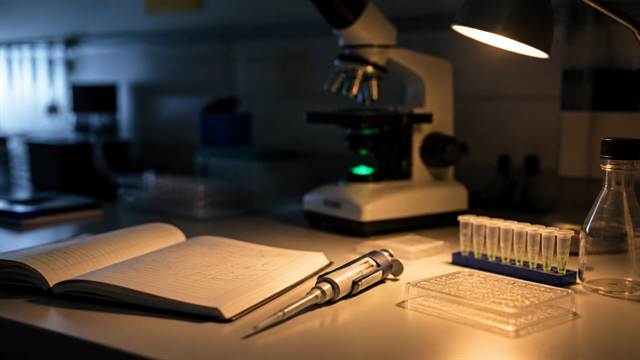
Featured image generated with OpenAI for BreathPharma.


Leave a Reply