
series by Abel B. Daartey
- Starting a PhD can feel exciting on the outside, but deeply uncertain on the inside.
- My first day in the lab reminded me that admission into a programme is not the same thing as feeling prepared for it.
- This is a story about confusion, quiet fear, and the slow process of learning how to belong in science.
There is a kind of confidence you have before you actually enter the room.
Before my first real day in the lab, I had already created a version of myself in my head. That version was calm, focused, serious, and maybe even a little impressive. I had made it into a PhD programme, so some part of me believed I should already look like I belonged there.
Then I walked into the lab.
And suddenly, all that confidence became very quiet.
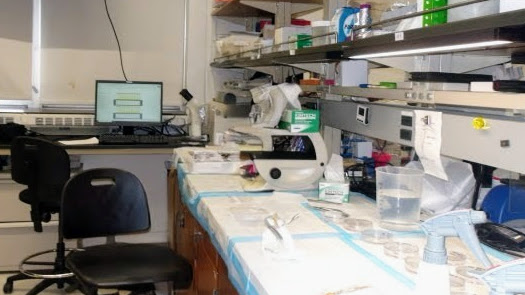
The lab was not intimidating in a dramatic way. Nobody was shouting. Nobody was trying to make me feel small. But everything around me seemed to carry a language I had not fully learned yet. The equipment, the labels on reagents, the way people moved from bench to bench like they already knew what mattered. Even the conversations sounded familiar and unfamiliar at the same time.
I could recognize some of the words, but I did not always understand the meaning behind them.
It was somewhere in a lab in Queens, NY tucked on a quiet floor that smelled faintly of ethanol and warm air from the incubators. Someone handed me a flask of neuroblastoma cells and asked me to split them — a task so routine to everyone else that no one thought to explain it slowly. I nodded like I understood, then spent the next hour quietly terrified that I would kill cells that had taken weeks to grow.
That first day reminded me that getting accepted into a PhD programme and feeling ready for a PhD programme are two very different things.
On paper, I had earned my place. In my mind, I was not so sure.
I remember trying to observe everything without looking lost. That is a special skill many new graduate students develop very quickly. You nod carefully. You smile when appropriate. You write things down even when you are not sure what the most important thing was. You hope nobody asks you a question that exposes the fact that your brain is still catching up.
Maybe some people enter the lab already feeling comfortable. That was not my experience.
My experience was curiosity mixed with silent panic.
I wanted to understand everything immediately. I wanted to ask good questions. I wanted to prove that I was not there by accident. But the more I watched, the more I realized how much I did not know. And that can be uncomfortable when you are used to surviving by being determined.
Determination is useful, but it does not automatically teach you how to passage cells, design primers, troubleshoot an assay, interpret confusing data, or understand why one tiny mistake can ruin an entire experiment.
The lab has its own humility.
It does not care how motivated you are if you skip a step. It does not care how badly you want results if your technique is poor. It does not care how much you studied if the biology is more complicated than your expectation.
That is not cruelty. That is training.
Still, on that first day, I did not know how to see it that way yet. I only knew that I was standing in a place I had worked hard to reach, while quietly wondering whether I was prepared enough to stay.
I remember standing at the biosafety cabinet, pipette in hand, thinking: everyone here can tell I don’t belong. No one had said it. It was just the loudest thought in the room.
Looking back, I think that feeling was more normal than I understood at the time. Many people begin graduate school believing they are the only ones who feel unprepared. We see others from the outside and assume they are confident. We do not see the questions they are afraid to ask. We do not see the failed attempts that trained them. We do not see how many times they also had to start from the beginning.
The first day in the lab did not make me a scientist.
It showed me how far I had to go.
And maybe that was the real beginning.
Not the acceptance letter. Not the first email. Not the official start date. The real beginning was standing in that lab and realizing that I would have to become comfortable with not knowing. I would have to learn in public. I would have to ask questions that made me feel exposed. I would have to accept correction, repeat basic tasks, and slowly build competence.
That is not always easy for a stubborn person.
The cowboy-in-training side of me wanted to figure things out quickly. It wanted to be tough, independent, and unshaken. But science does not always reward that kind of toughness. Sometimes the better scientist is the one who says, “Can you show me that again?” Sometimes the stronger student is the one who admits, “I do not understand this yet.”
That word “yet” matters.
I did not understand everything yet.
I did not feel fully confident yet.
I did not know how to move in the lab like I belonged there yet.
But I was there. I was learning. And even if I was silently panicking, I had not turned around.
That first day taught me something I still carry: belonging is not always a feeling you have at the beginning. Sometimes belonging is built slowly, through repetition, correction, failure, and the decision to return.
The lab did not become familiar in one day.
But that day gave me my first lesson.
A PhD is not only about entering a new space. It is about allowing that space to change you.


Leave a Reply