series by Abel B. Daartey
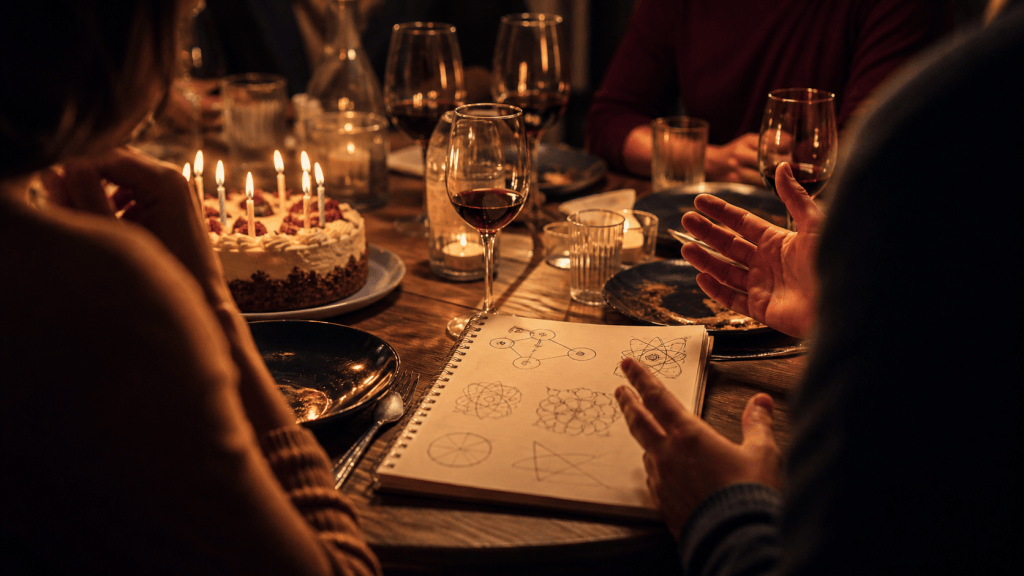
I went to a birthday celebration expecting food, laughter, and cake.
I did not expect to spend the afternoon explaining depression, childhood cancer, chemotherapy resistance, epigenetics, cell signaling, and why I chose to do a PhD.
But that was exactly what happened.
By the time I left the restaurant that evening, I had learned something important. Sometimes, science communication does not happen in a classroom, at a conference, or inside a laboratory. Sometimes, it happens at an ordinary birthday dinner, with ordinary people who are simply curious and willing to listen.
The occasion was the 78th birthday of my friend, Mr. Cooks.
I met him through another friend when we were neighbors. Over the years, he has shown us so much kindness. He buys us Christmas and birthday gifts, takes us to restaurants around Queens, and treats us with genuine care.
Every year, he invites people from different backgrounds to celebrate his birthday at a restaurant near Union Turnpike and St. John’s University. This year, I sat at a round table with a U.S. Army colonel who was close to retirement and a retired financial analyst who asked me to call her “Grandma.”
Grandma was warm, funny, and very curious.
The colonel told me he had traveled to Cote d’Ivoire during his military service. That immediately created a connection because Cote d’Ivoire shares a border with Ghana, and it is close to the region where I grew up.
What started as a simple conversation about Ghana soon became a much deeper discussion.
The colonel asked me where I came from and what I was studying.
I told him I studied pharmacy at Kwame Nkrumah University of Science and Technology in Ghana. I also explained that I later started a master’s program in neuropharmacology before transitioning into the PhD program in Pharmaceutical Sciences at St. John’s University.
The moment I mentioned neuropharmacology, the table became interested.
“What were you studying?” someone asked.
“Depression,” I said.
That one answer opened the door to many questions.
How do you study depression?
How is depression diagnosed?
How do doctors know the difference between depression and anxiety when some symptoms can look similar?
Before answering, I made one thing clear. I am not a medical doctor or psychiatrist. I have a pharmacy background and studied neuropharmacology, but I was not giving anyone medical advice.
Then I explained it in the simplest way I could. Researchers can study certain features related to depression using carefully designed models, while clinicians look at the full picture of a person’s symptoms. They consider the type of symptoms, how long they have lasted, how severe they are, and how much they affect daily life.
At the table, I was trying to remember the name of the manual used in mental health diagnosis. For a moment, my brain almost betrayed me. I nearly called it DMV. But what I meant was DSM, the Diagnostic and Statistical Manual of Mental Disorders.
That small moment reminded me of something very real. When you are explaining science to people outside your field, knowing the facts is not enough. You must also find words that people can enter through.
Then Grandma asked me another thoughtful question.
“Why did you leave depression research and move into cancer research?“
That question stayed with me.
I explained that before coming to the United States, I had imagined continuing in neuropharmacology. But I also knew that cancer research in Ghana still needed more training, facilities, and resources. I felt that if I could receive advanced training in cancer research, maybe one day I could contribute something useful back home and beyond.
I also told them something more personal.
Growing up, I saw how some illnesses that looked like cancer were sometimes explained as witchcraft. When people do not understand a disease, fear can replace knowledge. Stigma can replace medical help. I wanted to be part of the people helping others understand that cancer is a biological disease, not a supernatural punishment.
Then they asked what I study now.
I told them my work focuses on childhood cancers, especially neuroblastoma and medulloblastoma. I explained that some childhood cancers respond to treatment, but others resist therapy or come back after treatment. That is where research becomes important.
My research is trying to understand how some cancer cells survive treatments that are meant to kill them.
Then the colonel asked a question every PhD student should be ready to answer:
“What is new about your research?”
I could have started with big scientific words: epigenetics, cell signaling, tumor suppressors, drug resistance, transcriptional regulation.
But those words alone would not help them understand.
So I used an example.
I told them to imagine investigators trying to capture a group of criminals. The investigators may block one escape route, but the criminals may find another road, change their appearance, or learn how the investigators operate. To catch them, you must understand their escape plans.
Cancer cells can behave in a similar way.
A treatment may kill many cancer cells, but a few cells may survive by changing how they behave. They may activate survival pathways, repair damage, or change which instructions they follow inside the cell. Those surviving cells can later grow again and contribute to treatment resistance.
So I told them that my research is asking a simple question:
What escape routes are these cancer cells using?
When I explained it that way, I could see the table following me.
Then came epigenetics.
That one was harder.
I described DNA as a big instruction book inside the cell. Most cells may carry the same book, but not every cell reads the same pages at the same time.
Epigenetics is like bookmarks, highlighters, dimmer switches, or closed covers placed on that book. It does not always rewrite the DNA itself. Instead, it helps control which instructions the cell can read and how strongly the cell follows them.
Cancer cells can misuse these controls. They can silence instructions that normally stop uncontrolled growth, or activate instructions that help them survive treatment.
Then I explained cell signaling as the communication system of the cell. Cells are always sending and receiving messages about when to grow, divide, repair damage, or stop. Cancer cells can interfere with those messages and push the system toward survival.
For the first time that afternoon, I felt that my science was not trapped inside technical vocabulary anymore.
The people around the table were listening. They were asking questions. They were understanding the big picture.
Later, someone asked why I chose a PhD instead of practicing pharmacy.
I explained that during pharmacy school, I met professors whose work shaped how I saw science. I admired how they used research to ask difficult questions and generate knowledge that could one day improve treatment. By my fourth year, I knew research was becoming a major part of my future.
I also told them that I do not expect my PhD project alone to cure childhood cancer. Science does not usually move that way. But every careful experiment answers one small question. And each small answer can become part of a larger effort to help children with cancer receive better and more durable treatments.
When I finished speaking, the people at the table applauded.
That moment made me happy, but what moved me more was that they understood me. Not every molecular detail, of course. But they understood the problem, why it mattered, and why I cared.
That is the purpose of science communication.
Later, we returned to the celebration. We sang for Mr. Cooks, cut the cake, and wished him many more years of good health and happiness.
At the end, there was still plenty of food left. Grandma firmly told me to pack some.
“You are a student,” she reminded me. “Do not be shy.”
She told me to take some home and share it with the people I lived with. To her, the food should not go to waste. It should carry the love from that birthday table into another home.
We also discovered during our conversation that we were both Catholic. She invited me to her church, and I hoped to worship with her the following Sunday.
It was a warm ending to a day I did not expect.
I arrived at the restaurant to celebrate a kind man’s birthday. I left with a renewed understanding of my responsibility as a scientist.
Knowing the science is important. Doing rigorous research is important. But our responsibility should not always end at the laboratory door.
We must also learn how to explain why the work matters.
To patients.
To families.
To communities.
To policymakers.
And sometimes, to curious strangers sitting beside us at a birthday dinner.
Science communication does not mean making science childish. It means making science understandable without making it false.
That afternoon, my classroom was a restaurant. My teaching tools were criminals, investigators, instruction books, bookmarks, and communication networks. My audience was a colonel, a retired financial analyst called Grandma, and a group of new friends.
And the lesson was simple:
If people cannot understand our science, they cannot fully appreciate its value. Sometimes, the first step toward changing the world is learning how to explain what we are trying to change.
Featured image generated with OpenAI for BreathPharma.


 BreathPharma
Leave a comment