
Written and edited by Abel B. Daartey, PharmD
- EGCG, the main catechin in green tea, affects cancer-related pathways in cell and animal studies, including growth signaling, inflammation, oxidative stress, and gene silencing.
- Human evidence is less settled. The strongest review evidence says green tea’s cancer-prevention benefit remains limited and inconsistent.
- Drinking green tea can fit into a healthy diet, but high-dose green tea extract pills can injure the liver. More is not always safer.
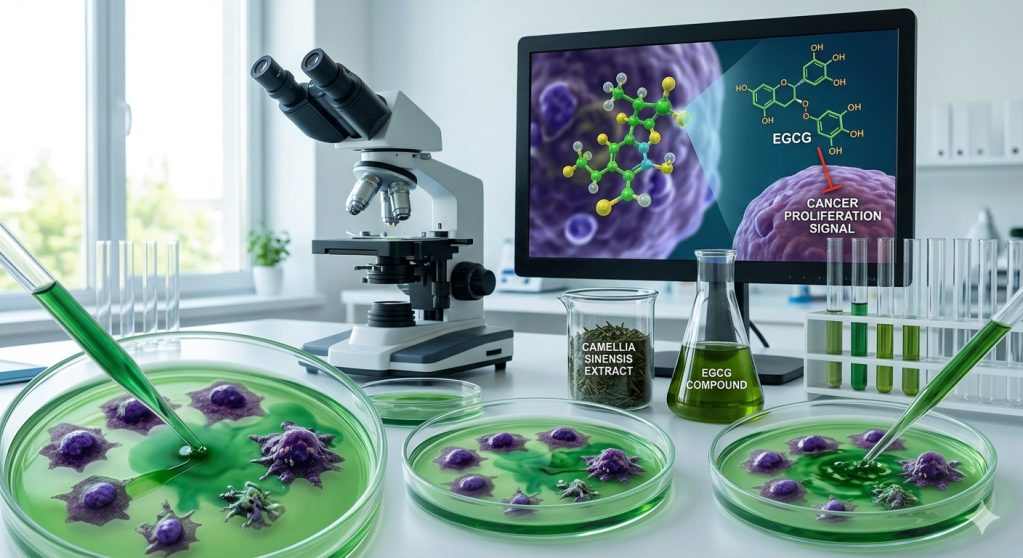
Green tea has one of the best-known plant compounds in cancer-prevention research: epigallocatechin-3-gallate, usually shortened to EGCG. In laboratory studies, EGCG can slow cancer-cell growth, trigger cell death, reduce inflammatory signaling, and affect epigenetic enzymes that help control gene activity [1-3].
That sounds powerful, but the important question is whether the same thing happens in people who drink green tea. The answer is more cautious. EGCG is biologically active, but drinking green tea is not the same as treating cancer cells in a dish. The body has to absorb it, modify it, and clear it. The amount that reaches tissues after normal tea drinking is much lower than many lab experiments use.
The Bottom Line Up Front
Green tea is a reasonable healthy drink for many people. It is not a cancer treatment. The most careful position is this: EGCG is one of the most studied dietary polyphenols in cancer biology, but human cancer-prevention evidence remains inconsistent. A 2020 Cochrane review of 142 studies and more than 1.1 million participants concluded that evidence for green tea reducing cancer risk is limited and inconsistent, and that high-dose extracts deserve caution [4].
What EGCG Is
Green tea comes from Camellia sinensis. Unlike black tea, green tea leaves are processed in a way that preserves more catechins, a family of polyphenols. EGCG is the most abundant and heavily studied catechin in green tea [5].
In basic science studies, EGCG is interesting because it does not seem to hit only one target. It touches several pathways that cancer cells often depend on. That broad activity is exciting for prevention research, but it also makes clinical interpretation harder. A compound with many weak effects in the lab does not automatically become a useful therapy in humans.
How EGCG Affects Cancer-Related Pathways
1. Growth and survival signaling. Many cancers depend on pathways such as PI3K, Akt, mTOR, MAPK, and EGFR-related signaling. EGCG has been reported to reduce activity in some of these pathways in several cancer-cell models [1,2]. In plain language, it can interfere with signals that tell abnormal cells to grow, divide, and resist death.
2. Cell-cycle arrest and apoptosis. Cancer cells escape normal controls on division. EGCG studies often report changes in cyclins, CDKs, p21, p27, p53-related signaling, caspases, Bcl-2 family proteins, and other regulators of cell-cycle arrest or apoptosis [2]. This is one reason EGCG keeps appearing in cancer biology papers.
3. Inflammation and oxidative stress. EGCG can influence inflammatory transcription factors such as NF-kB and can also interact with antioxidant-response systems such as Nrf2 [1,5]. This dual role can be confusing: EGCG may behave as an antioxidant in some settings and as a pro-oxidant stressor in cancer cells in others. Context matters.
4. Epigenetic gene control. One classic study reported that EGCG inhibited DNA methyltransferase activity and reactivated methylation-silenced genes in cancer cell lines, including genes such as p16, RAR-beta, and MGMT [3]. This is an important mechanistic finding, but it is still mostly a laboratory observation. It should not be read as proof that drinking tea reverses gene silencing in human tumors.
What Population Studies Show
Population studies often find that people who drink tea have different health outcomes than people who do not. Some studies suggest lower risk for certain cancers or lower all-cause mortality among regular tea drinkers [6]. But observational studies have a built-in problem: tea drinkers may also differ in diet, smoking, alcohol use, income, health care access, body weight, physical activity, and other habits.
The Cochrane review is useful because it looked broadly across randomized trials and observational studies. Its conclusion was not that green tea is useless. It was that the evidence is not strong enough to claim a proven cancer-prevention effect [4]. That nuance is important for readers who see exaggerated supplement claims online.
Bioavailability Is the Big Barrier
EGCG does not simply enter the blood unchanged and travel to tumors in high concentration. It is unstable under some conditions, absorbed imperfectly in the gut, and modified by methylation, glucuronidation, and sulfation [7]. Gut microbes may also transform tea polyphenols into other metabolites. Some of those metabolites may have their own biological effects, but the field is still working out what matters most in humans.
This is why normal green tea and concentrated green tea extract pills should not be treated as the same thing. A cup of tea delivers EGCG with water, caffeine, other catechins, and a low dose. A supplement can deliver a much higher dose, sometimes on an empty stomach, and with less predictable safety.
Safety: The Extract Warning Matters
Most people tolerate brewed green tea well. The concern is concentrated green tea extract. The United States Pharmacopeia reviewed liver-injury reports and concluded that green tea extracts can be linked to hepatotoxicity in some cases, especially concentrated products [8]. The Cochrane review also noted adverse effects from green tea extract supplementation, including gastrointestinal symptoms and elevated liver enzymes [4].
If someone is receiving cancer treatment, pregnant, has liver disease, takes blood thinners, or uses several medications, they should not add strong green tea extract supplements without medical guidance. “Natural” does not always mean safe with oncology drugs.
The Bottom Line
Green tea is a good example of how nutrition science can be both promising and over-marketed. EGCG clearly affects cancer-related biology in experimental systems. But human evidence does not support using green tea as a cancer treatment, and it does not prove that green tea prevents cancer by itself.
For everyday life, brewed green tea can be part of a healthy diet. For cancer prevention, it should sit beside the bigger evidence-based habits: avoid tobacco, limit alcohol, maintain a healthy weight when possible, eat a varied diet, move regularly, vaccinate when appropriate, and follow recommended screening.
This article is for educational purposes only and should not be used as personal medical advice. People with cancer, liver disease, pregnancy, or complex medication regimens should talk with a qualified health professional before using green tea extract supplements.
References
- Yang CS et al. Cancer prevention by tea. Nat Rev Cancer. 2009;9:429-439. doi:10.1038/nrc2641.
- Singh BN et al. Green tea catechin, epigallocatechin-3-gallate: mechanisms, perspectives and clinical applications. Biochem Pharmacol. 2011;82:1807-1821. doi:10.1016/j.bcp.2011.07.093.
- Fang MZ et al. Tea polyphenol EGCG inhibits DNA methyltransferase and reactivates methylation-silenced genes in cancer cell lines. Cancer Res. 2003;63:7563-7570. PMID:14633667.
- Filippini T et al. Green tea for the prevention of cancer. Cochrane Database Syst Rev. 2020;3:CD005004. doi:10.1002/14651858.CD005004.pub3.
- Khan N and Mukhtar H. Tea polyphenols in promotion of human health. Nutrients. 2019;11:39. doi:10.3390/nu11010039.
- Inoue-Choi M et al. Tea consumption and all-cause and cause-specific mortality in the UK Biobank. Ann Intern Med. 2022;175:1201-1211. doi:10.7326/M22-0041.
- Yang J et al. Tea polyphenol EGCG and the gut-health axis. Adv Nutr. 2025;16:100545. doi:10.1016/j.advnut.2025.100545.
- Oketch-Rabah HA et al. United States Pharmacopeia comprehensive review of the hepatotoxicity of green tea extracts. Toxicol Rep. 2020;7:386-402. doi:10.1016/j.toxrep.2020.02.008.
Featured image created using Google Gemini AI.


Leave a Reply