
series by Abel B. Daartey
- Innovation doesn’t always feel innovative — feeling stuck is often “fermenting,” not failing.
- Rest is a real research strategy: naps and detours often spark the best ideas.
- Innovation is mostly observing what’s already there and connecting it in new ways — so show up, stay curious, and keep moving.
Let me confess something scholars rarely admit: between referencing Foucault and Googling “how to cure existential dread with coffee.”
I feel as innovative as a paperclip in the age of ChatGPT.
You know, when I started my PhD, I imagined myself as a Jumping Jack—bouncing into lab, firing up datasets, and high-kicking my way through academic conferences while quoting Einstein and ordering coffee.
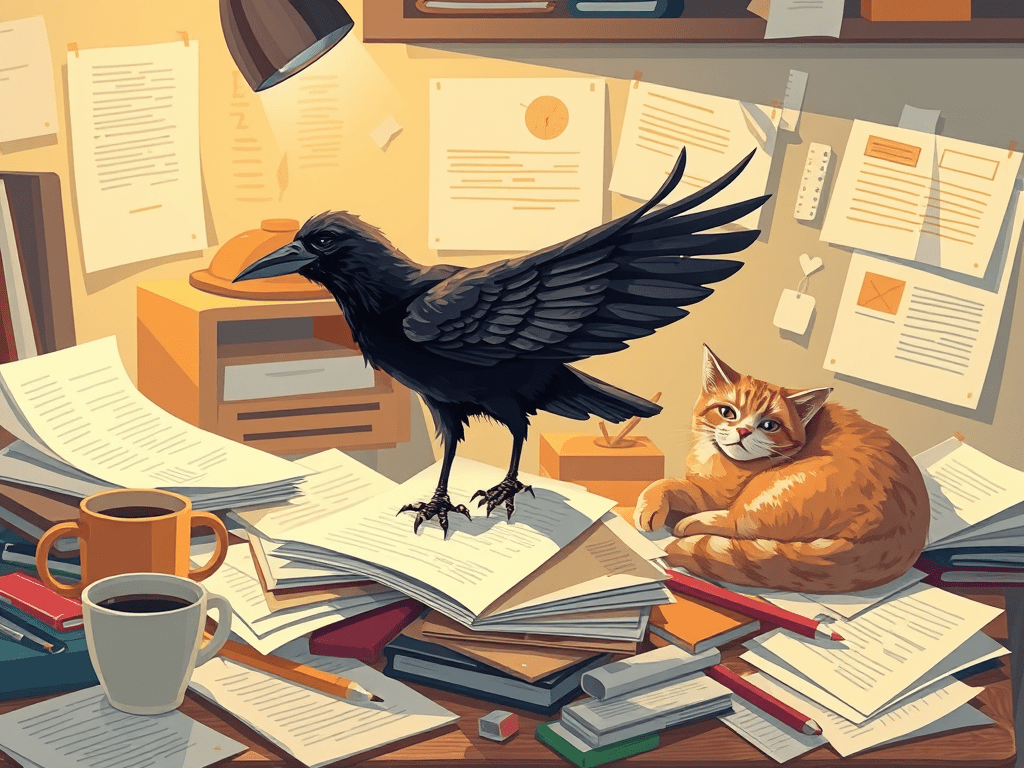
Fast-forward to today. I’m more like a crow—perched on my desk, staring at my half-written paper titled “A Preliminary Observation of Something Potentially Observational.” I peck at sentences. I hoard PDFs I’ll never read. Occasionally, I caw when someone takes the last free snack at seminars.
Then there’s the Cat phase—aloof, curled up on my imposter syndrome, hissing at anyone who dares ask,
“So how’s your research going?” Fine!. It’s going fine. Huh, I just renamed my folders for the fifth time and called it ‘data organization.’
But here’s the first lesson:
🧠 Innovation doesn’t always feel innovative. Most great ideas start out as “Wait, is this stupid?” and end with a published paper cited by your mother and a Russian bot. You’re not failing – you’re fermenting.
😹 Second lesson: Innovators have naps. Edison napped. Einstein napped. Cats nap. Coincidence? I think not. That midday flop on your desk? It’s a breakthrough in disguise.
🦅 Third lesson: Stop hunting genius. Observe it. Crows solve puzzles with sticks. Cats manipulate humans into opening canned food. Innovation is often about observing what’s already there and connecting it in ridiculous ways. Like me, who uses coffee consumption trends to predict my productivity—technically, that’s predictive modeling.
🤸🏾 Final lesson: Be your own Jumping Jack. Move. Talk to people. Join weird workshops. Draw your research with crayons. Sometimes, innovation doesn’t need a eureka—it needs a detour.
So no, I might not be building robots that sing or discovering anti-aging bacteria from yak milk. But I’m showing up, every day, flapping my wings and flexing my curiosity. That counts.
And if all else fails, just remember: even Schrödinger’s Cat didn’t know what was going on half the time. You’re in good company.


Leave a Reply