series by Abel B. Daartey
- How many papers you have by year 3 depends hugely on your field — it is a poor measure of how good your PhD actually is.
- Industry jobs in pharma, biotech, and regulatory science do not require publications; they hire for skills and problem-solving.
- Real progress often does not show up on a CV — your thinking, skills, and depth are growing even when papers are not.
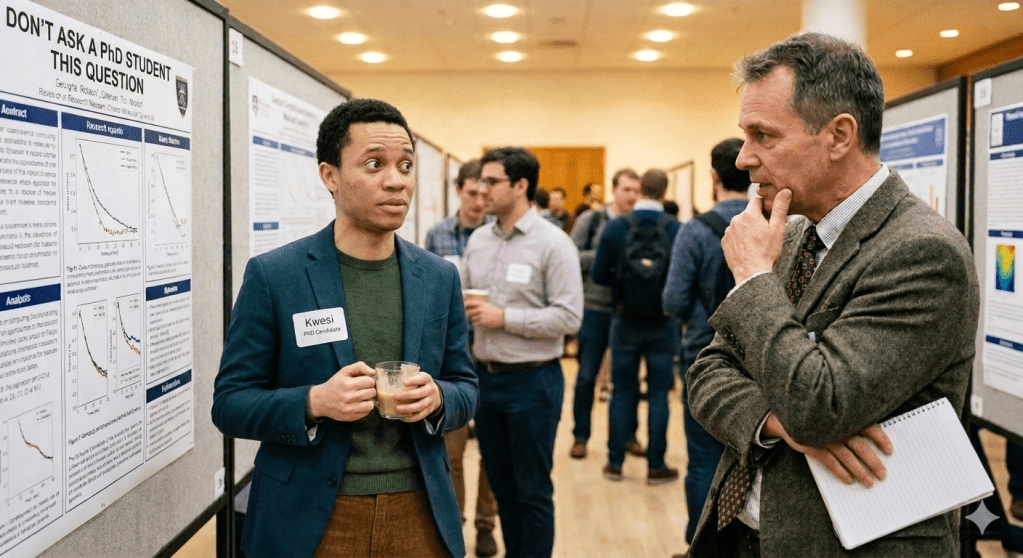
There is a particular kind of silence that descends on a PhD student when someone at a conference, a family dinner, or a casual departmental mixer turns to them and asks, with complete innocence and no idea what they are doing, the question.
“So, which year are you, and how many papers have you published?”
It is a simple question. Two parts. Grammatically unremarkable. And yet, somewhere between the words “how many” and “published,” something in the PhD student’s central nervous system initiates a threat response not entirely unlike what a gazelle experiences when it hears a twig snap on the savanna.
The Answer, Technically
The honest answer, for a significant proportion of doctoral candidates at any given moment, is some version of: “I am in my third year, and the number of published papers is a figure I prefer not to discuss in polite company.”
Third year. The year that sounds like you should absolutely have things figured out. The year that comes after the year where you were new and forgiven everything, and after the year where you were “settling in” and still forgiven everything. Third year is when the universe, and your supervisor, begins to raise an eyebrow.
And the thesis. Oh, the thesis. It sits on your desktop, in your Google Drive, in three backup folders you made during a moment of paranoid productivity, and across seventeen browser tabs you have not closed since February. It is simultaneously the most important document you have ever written and a file you have not opened since Tuesday. It is eating you. You are, in a very real biochemical sense, being slowly digested by a Word document.
The Internal Monologue When the Question Lands
What the person asking hears: a brief pause.
What is actually happening inside the PhD student’s prefrontal cortex during that pause:
Do I count the conference abstract? I submitted it. It was accepted. No one reads those. Do I count the literature review chapter I technically wrote 18,000 words of? That is not published. What about the methods section? No. What about the paper that is “under review,” the one that has been under review since the previous academic year? Is that one? No. What about the one that is “in preparation”? It is in preparation in the same sense that a soufflé I have never started making is in preparation. The data exists. The story is mostly there. I have a title. That is something.
The pause ends. You say: “I have one under review.”
You have done it. You have technically said nothing false. You are a scientist. Precision matters.
The Myth of the Third-Year Paper Count
Here is something no one tells you before you start a PhD, mostly because people who have finished theirs develop a selective amnesia about the experience that is probably a protective neurological mechanism: the published paper count of a third-year PhD student varies enormously, it correlates poorly with eventual thesis quality, and the students who have three first-author papers in year three are either in computational fields where a paper can be turned around in six weeks, working on an extremely productive team, or quietly not sleeping.
Meanwhile, if you are doing wet lab work, actual bench science where cells die when they feel judged, assays work perfectly for one week and then never again, and reagents arrive two months late and expire one month after, your paper timeline operates on geological rather than academic time. You measure progress in optimised protocols. In gels that finally looked the way they were supposed to. In the afternoon the Western blot came out clean and you stood in the darkroom for a moment just breathing.
That moment does not show up on a CV. But it happened. And it mattered.
What Third Year Actually Means
Third year, if we are being precise about the lived experience, is the year where you know enough to know how much you do not know. It is the year where you have read several hundred papers, which has mainly taught you that every answer produces three more questions, and that the literature is less a body of settled knowledge and more a large ongoing argument between scientists who have strong feelings about methodology.
You have presented at lab meeting enough times that you no longer panic when someone asks a question you cannot answer. You have simply learned to say “that is a great point, I will look into that” with the calm confidence of someone who has been saying it for two and a half years and has occasionally, genuinely, looked into it.
You have eaten lunch at your desk so many times that your desk chair has learned the shape of your uncertainty. You have explained your research project to enough non-scientists, parents, distant relatives, the person who cuts your hair, that you now have three versions of the elevator pitch: the accurate one, the simplified one, and the one you use at Christmas that involves the word “basically” six times and ends with “…so yeah, cancer stuff.”
But Do You Need Papers for Industry Though?
Oh, absolutely not. Industry does not care. And I know this. I have read it. I have been told it. I have repeated it to others with great confidence at 2am when I could not sleep.
Industry wants skills. Industry wants problem-solvers. Industry wants someone who can sit in a meeting and look calm while internally running seventeen contingency plans. Industry does not go to PubMed and search your name before the interview.
I know all of this. I am completely at peace with all of this.
And yet. There I am, at the conference poster session, watching a second-year with three publications casually mention their fourth submission, and something in me dies quietly, like a cell line that just stopped growing for no documented reason.
The point is: no papers, no problem. Industry is fine. Everything is fine. I am fine. The thesis is fine. We are all fine here.
The Honest Truth About the Question
The people who ask how many papers you have published almost never mean it as a challenge. They are asking because they are interested, because academia is genuinely mysterious to most people, because they want to understand what it is you are actually doing with your life in that lab at 8pm on a Thursday.
And the answer, the real one, is that you are building something. Slowly, sometimes painfully, occasionally with great excitement and more often with patient, grinding, methodical effort. You are learning how to think at a level of precision that most people never need. You are contributing, incrementally, to a body of knowledge that will still be there long after the thesis anxiety has faded.
The papers will come. The thesis will, eventually, stop eating you and become something you have written. The third year will become the fourth, and the fourth will become the defence, and the defence will become a title you carry for the rest of your career.
But first: go close one of those seventeen browser tabs. Just one. You can do it. I believe in you.


Leave a Reply