
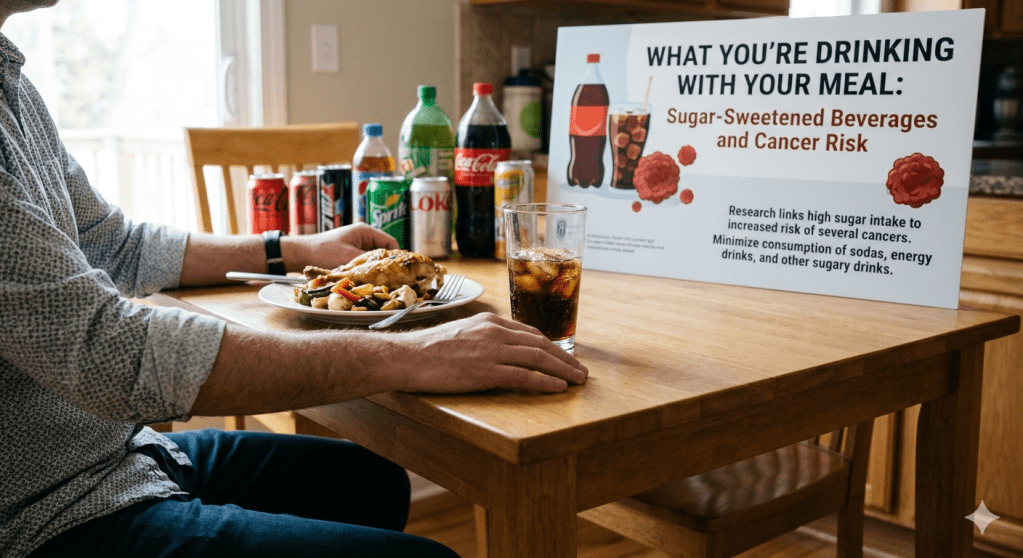
Written and edited by Abel B. Daartey, PharmD
- Sugary drinks raise cancer concern mostly through weight gain, insulin resistance, fatty liver, and long-term inflammation.
- Large cohort studies have linked higher sugary-drink intake with overall cancer, breast cancer, and early-onset colorectal cancer risk, but these studies show association, not proof by themselves.
- Diet drinks are not a perfect answer either. The evidence is mixed, so the simplest routine choice is water, unsweetened tea, or drinks with little added sugar.
Sugar-sweetened beverages are easy to overlook because they do not feel like a meal. Soda, sweetened iced tea, fruit drinks, energy drinks, sports drinks, and many sweet coffee drinks can add a lot of sugar before the body has even registered fullness. That matters because sugary drinks are strongly tied to weight gain and metabolic disease, and excess body fat is now recognized as a cause of several cancers [1,2].
This does not mean a soda directly causes cancer. Cancer is rarely that simple. The concern is what repeated exposure can do over years: more added calories, higher insulin demand, more visceral fat, fatty liver, low-grade inflammation, and changes in the gut environment. Those are the biological conditions that can make cancer development more likely.
The Obesity Pathway
The clearest cancer pathway starts with excess body fat. The International Agency for Research on Cancer and the World Cancer Research Fund have both linked excess body fatness to multiple cancers, including colorectal, endometrial, post-menopausal breast, liver, kidney, pancreatic, and esophageal cancers [1,2]. Sugary drinks contribute because liquid calories are not very filling. A person can drink hundreds of calories quickly and still eat a normal meal.
Fat tissue is also not just storage. It releases hormones and inflammatory signals. Higher leptin, lower adiponectin, insulin resistance, and chronic inflammation can all push cells toward growth and survival signals that cancer cells also use.
Insulin, IGF-1, and Growth Signals
Sugary drinks are absorbed fast, so they can produce quick spikes in blood glucose and insulin. Over time, frequent high-sugar intake can contribute to metabolic syndrome and type 2 diabetes [3]. These conditions are marked by chronic insulin resistance and altered growth signaling.
Insulin and insulin-like growth factor 1, often called IGF-1, are not cancer-causing toxins. They are normal human signals. The problem comes when these growth signals stay high for a long time. In that setting, pathways such as PI3K, Akt, and mTOR can become more active, making it easier for abnormal cells to survive and divide.
What Human Studies Have Found
Several large observational studies have found a link between sugary drinks and cancer risk. In the French NutriNet-Sante cohort, each additional 100 mL per day of sugary drinks was associated with higher overall cancer risk and higher breast cancer risk [4]. The authors adjusted for many factors, including body mass index, but observational studies still cannot prove cause on their own.
Another important study followed women in the Nurses’ Health Study II and focused on early-onset colorectal cancer, meaning colorectal cancer diagnosed before age 50. Women who drank two or more sugar-sweetened beverages per day had a higher risk than women who drank less than one per week [5]. This does not prove sugary drinks are the only driver of early-onset colorectal cancer, but it makes them a reasonable target for prevention.
Diet Drinks Need a Careful Explanation
Many people switch from regular soda to diet soda. That may reduce sugar and calories, but it does not make the science simple. The National Cancer Institute notes that studies of artificial sweeteners and cancer in humans have mostly been reassuring, although some findings are inconsistent [6]. In 2023, IARC classified aspartame as “possibly carcinogenic to humans” based on limited evidence, while the WHO/FAO expert committee JECFA kept the acceptable daily intake at 0 to 40 mg/kg body weight [7].
So the practical message is not panic. It is balance. Diet drinks may help some people reduce sugar intake, but they should not become the main daily fluid. Water, sparkling water without added sugar, unsweetened tea, and plain coffee are still cleaner long-term habits.
Fructose and the Liver
Many sweet drinks contain sucrose or high-fructose corn syrup. Fructose is handled heavily by the liver. In high amounts, especially from drinks, it can promote liver fat production, triglycerides, and non-alcoholic fatty liver disease [8]. When fatty liver progresses to inflammation and scarring, liver cancer risk can rise over time.
This does not mean fruit is the same as soda. Whole fruit comes with fiber, water, and a slower eating pattern. The issue here is concentrated sugar in liquid form, taken repeatedly.
The Childhood Angle
Drink habits start early. Children and teenagers who get used to sweet drinks may carry that pattern into adulthood, when metabolic risk begins to accumulate. Replacing sweet drinks in the home is one of the simpler prevention steps families can make. It does not require a perfect diet. It just removes a repeated daily exposure.
The Bottom Line
Sugary drinks do not act like cigarettes, where one exposure category has a very direct cancer story. Their risk is more indirect and metabolic. Still, the evidence is strong enough to take seriously. Cutting back on sugary drinks supports weight control, insulin health, liver health, and probably cancer prevention too.
This article is for educational purposes only and should not be used as personal medical advice. If you have diabetes, liver disease, cancer, or are making major diet changes during treatment, speak with your health care team.
References
- Lauby-Secretan B et al. Body fatness and cancer. N Engl J Med. 2016;375:794-798. doi:10.1056/NEJMsr1606602.
- World Cancer Research Fund. Weight and cancer risk.
- Malik VS et al. Sugar-sweetened beverages and risk of metabolic syndrome and type 2 diabetes. Diabetes Care. 2010;33:2477-2483. doi:10.2337/dc10-1079.
- Chazelas E et al. Sugary drink consumption and risk of cancer: results from NutriNet-Sante prospective cohort. BMJ. 2019;366:l2408. doi:10.1136/bmj.l2408.
- Hur J et al. Sugar-sweetened beverage intake in adulthood and adolescence and risk of early-onset colorectal cancer among women. Gut. 2021;70:2330-2336. doi:10.1136/gutjnl-2020-323450.
- National Cancer Institute. Artificial Sweeteners and Cancer.
- WHO/IARC/JECFA. Aspartame hazard and risk assessment results released. 2023.
- Stanhope KL. Sugar consumption, metabolic disease and obesity. Crit Rev Clin Lab Sci. 2016;53:52-67. doi:10.3109/10408363.2015.1084990.
Featured image created using Google Gemini AI.


 BreathPharma
Leave a comment