
Written and edited by Abel B. Daartey, PharmD
- Moringa contains bioactive compounds that can affect cancer cells in laboratory and animal studies.
- The evidence is still early. Moringa has not been proven in humans to prevent cancer or treat cancer.
- Food-level moringa may fit into a normal diet for many people, but strong supplements should be discussed with a clinician, especially during cancer treatment.
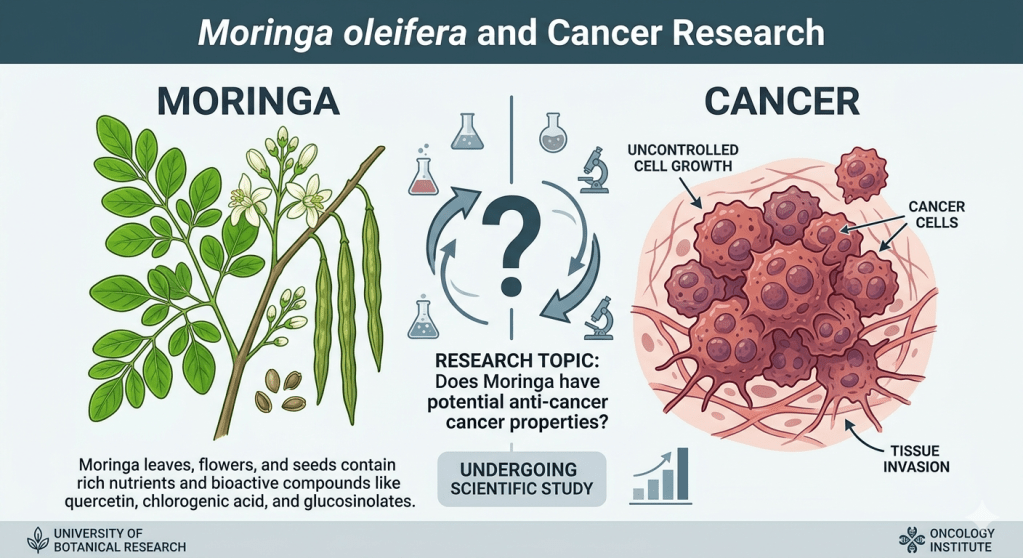
Moringa oleifera is often promoted online as a “superfood” with anticancer power. The science is more interesting, and more limited, than the marketing. Moringa leaves and seeds contain compounds that can affect oxidative stress, inflammation, cell-cycle control, apoptosis, and immune signaling in experimental cancer systems [1-5].
That does not make moringa a cancer treatment. Most cancer-related evidence comes from cell cultures, animal models, docking studies, and reviews of early experiments. Human cancer efficacy trials are not established at the level required for oncology practice. So the honest summary is simple: moringa is pharmacologically interesting, but it is not a validated cancer therapy.
The Compounds Behind the Interest
Moringa’s cancer research is usually linked to several groups of phytochemicals. One group is glucosinolates and isothiocyanates. Moringa contains glucomoringin, which can be converted into moringin, a rhamnosylated isothiocyanate [6]. Isothiocyanates are also found in foods like broccoli and watercress, but moringa’s specific compounds are chemically distinct.
Moringa also contains flavonoids and phenolic acids such as quercetin, kaempferol, chlorogenic acid, and ellagic acid. In a 2023 in silico and in vitro study, several moringa compounds were proposed to interact with CDK2, and a moringa leaf fraction reduced viability of estrogen-receptor-positive breast cancer cells in culture [1]. That is useful early pharmacology, but it is not proof of tumor control in a person.
How Moringa Affects Cancer Cells in the Lab
1. Apoptosis. A repeated finding is that moringa extracts can push some cancer cells toward programmed cell death. A 2011 study reported reduced proliferation and apoptosis-related changes in human tumor cells treated with moringa leaf extract [3]. Other studies have described mitochondrial stress, reactive oxygen species, and caspase-related signaling.
2. Cell-cycle effects. Cancer cells divide when they should not. Some moringa studies report cell-cycle arrest or changes in CDK-related pathways [1,3]. This is one reason moringa shows up in cancer-prevention discussions, but the doses and extract types vary a lot between studies.
3. Inflammation and survival signaling. NF-kappaB is a major inflammatory and survival pathway. In pancreatic cancer cell experiments, aqueous moringa leaf extract down-regulated NF-kappaB signaling and increased the cytotoxic effect of cisplatin in cultured cells [2]. This is promising enough for more research, but patients should not combine supplements with chemotherapy on their own.
4. Immune microenvironment in animals. A 2023 Food & Function study found that moringa leaf polysaccharides affected tumor-associated macrophages in a Lewis lung cancer mouse model, shifting them toward a more antitumor pattern and promoting T-cell infiltration [4]. This is a strong preclinical signal, but it remains animal evidence.
Which Cancer Types Have Been Studied?
The experimental literature includes breast, liver, colorectal, pancreatic, lung, oral, cervical, prostate, lymphoma, and leukemia-related models [1-5,7]. That range is broad, but the studies are not all comparable. Different papers use different plant parts, extraction methods, solvents, concentrations, cell lines, animal models, and endpoints. This makes it hard to say which preparation, if any, would be useful in humans.
A 2025 systematic review of moringa’s biological properties found multiple reports of cytotoxic, apoptotic, and antiproliferative effects against cancer cell lines, but it also emphasized the need for more standardization, better safety evaluation, and clinical testing [5]. A 2026 lung cancer mini-review came to a similar conclusion: promising in vitro and in vivo findings, but more standardized animal and clinical studies are needed before therapeutic claims can be made [7].
Could It Help Alongside Chemotherapy?
This is the question many readers really care about. In theory, some moringa compounds might support anticancer pathways or make cancer cells more sensitive to treatment. In one pancreatic cancer cell study, moringa extract increased the effect of cisplatin in vitro [2]. But in vitro synergy is not the same as safe human combination therapy.
Supplements can change drug metabolism, platelet function, liver enzymes, kidney handling, immune activity, or oxidative stress. During chemotherapy, radiotherapy, immunotherapy, endocrine therapy, or targeted therapy, those changes can matter. This is why patients should bring supplement use to their oncology team instead of hiding it.
Food Is Different From Extract Pills
Moringa leaves used as food are not the same as concentrated extracts. Food-level use provides fiber, micronutrients, and plant compounds in a relatively modest dose. Extract pills can be stronger, less standardized, and harder to predict. The amount of active compound may differ across brands, harvests, storage conditions, and extraction methods.
That does not mean moringa food is dangerous. It means cancer claims should be separated from nutrition claims. Moringa can be a nutritious plant. That alone does not prove it prevents or treats cancer.
The Bottom Line
Moringa oleifera deserves scientific attention. Its compounds show real biological activity in cancer-related laboratory and animal models, including apoptosis, oxidative stress, inflammatory signaling, cell-cycle control, and immune microenvironment effects [1-7].
But meaningful biology is not the same as proven clinical benefit. There is no strong human evidence showing that moringa prevents cancer, shrinks tumors, or improves survival. For readers, the safest message is this: enjoy moringa as food if it fits your diet, but do not use moringa supplements as a substitute for diagnosis, screening, surgery, radiation, chemotherapy, immunotherapy, targeted therapy, or oncology follow-up.
This article is for informational purposes only and does not constitute medical advice. Anyone receiving cancer care should speak with a qualified oncology team before using supplements or plant extracts.
References
- Sultan R et al. The anticancer potential of chemical constituents of Moringa oleifera targeting CDK-2 inhibition in estrogen receptor positive breast cancer using in silico and in vitro approaches. BMC Complement Med Ther. 2023;23:396. doi:10.1186/s12906-023-04198-z.
- Berkovich L et al. Moringa oleifera aqueous leaf extract down-regulates NF-kappaB and increases cytotoxic effect of chemotherapy in pancreatic cancer cells. BMC Complement Altern Med. 2013;13:212. doi:10.1186/1472-6882-13-212.
- Sreelatha S et al. Antiproliferation and induction of apoptosis by Moringa oleifera leaf extract on human cancer cells. Food Chem Toxicol. 2011;49:1270-1275. doi:10.1016/j.fct.2011.03.006.
- Wang S et al. Moringa oleifera leaf polysaccharides exert anti-lung cancer effects upon targeting TLR4 to reverse the tumor-associated macrophage phenotype and promote T-cell infiltration. Food Funct. 2023;14:4607-4620. doi:10.1039/D2FO03685A.
- Soto JA et al. Biological properties of Moringa oleifera: a systematic review of the last decade. F1000Research. 2025;13:1390. doi:10.12688/f1000research.157194.2.
- Ponticelli M et al. Harnessing Moringa oleifera Lam’s isothiocyanates for targeted H2S delivery: a systematic review of the literature. Phytother Res. 2025. doi:10.1002/ptr.70146.
- Anticancer potential of Moringa oleifera in lung cancer: a mini review of in vitro and in vivo evidence. Current Cancer Drug Targets. 2026. doi:10.2174/0113895575450429260422051704.
- Kou X et al. Nutraceutical or pharmacological potential of Moringa oleifera Lam. Nutrients. 2018;10:343. doi:10.3390/nu10030343.


Leave a Reply