Written and edited by Abel B. Daartey, PharmD
- Long-term night shift work is classified by IARC as probably carcinogenic to humans, based on limited human evidence and stronger animal and mechanistic evidence.
- Sleep supports immune regulation, inflammation control, hormone timing, melatonin signaling, and DNA repair rhythms, but poor sleep is not a stand-alone cancer cause.
- A steady sleep routine and careful light exposure are sensible health steps, but they do not replace screening, vaccination, tobacco avoidance, diet, exercise, or medical care.
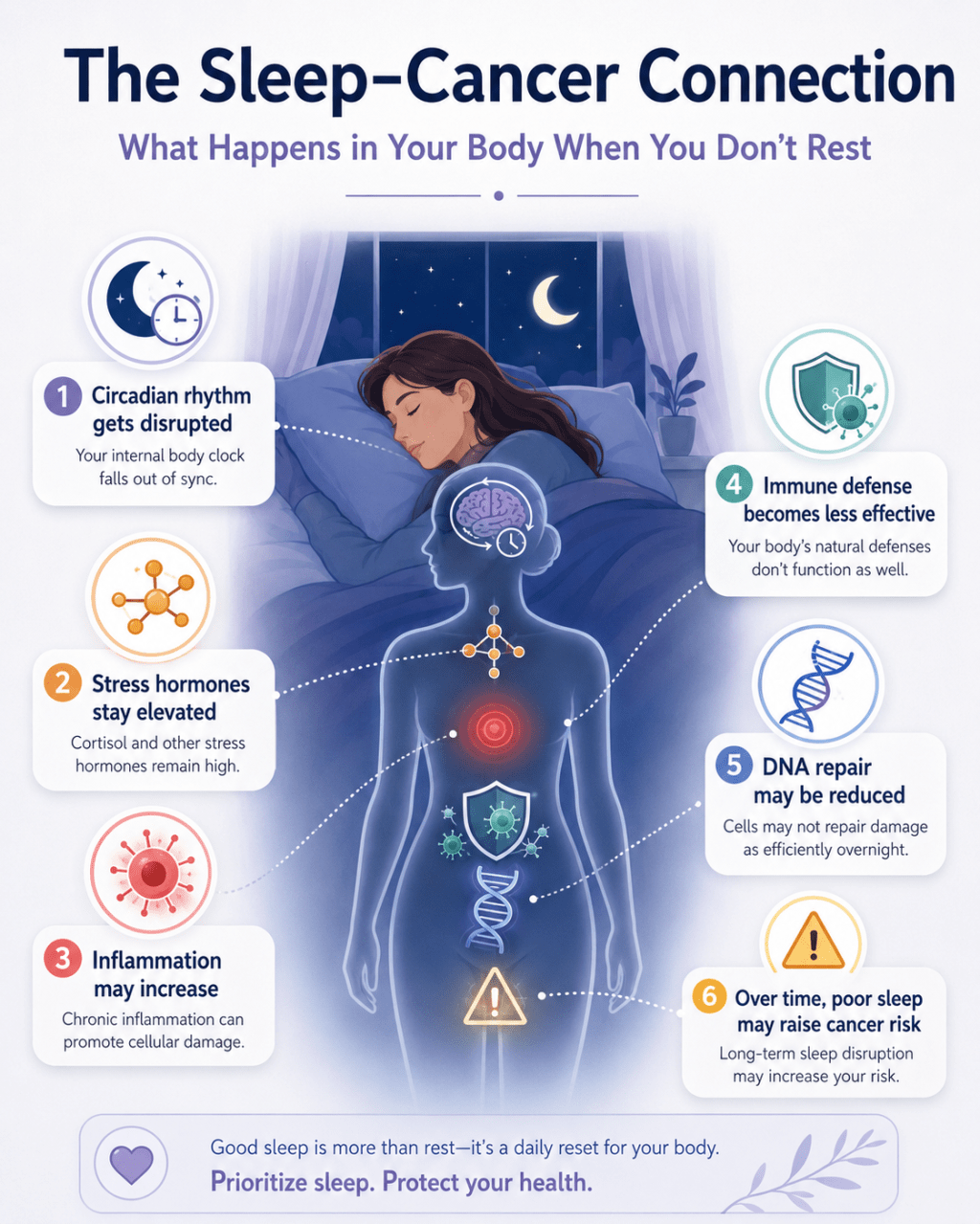
Poor sleep will not automatically cause cancer, and perfect sleep is not a cancer cure. But sleep and circadian rhythm help regulate systems that matter in cancer biology, including immune function, inflammation, hormone timing, melatonin signaling, cell-cycle control, and DNA repair rhythms [1-5].
The strongest warning signal is not one bad night. It is long-term circadian disruption. The International Agency for Research on Cancer classifies night shift work as “probably carcinogenic to humans” or Group 2A. IARC based that decision on limited human evidence for breast, prostate, colon, and rectal cancers, sufficient evidence in experimental animals, and strong mechanistic evidence [3].
For everyday sleep duration, the evidence is more mixed. A large systematic review and meta-analysis did not find a clear overall dose-response relationship between short sleep and total cancer risk, although some subgroup signals were reported [2]. So the public-health message should be careful: protect sleep because it supports normal biology, but do not present sleep as a cancer-prevention treatment by itself.
Why the Body Clock Matters
Nearly every cell contains a molecular clock. This clock uses genes and proteins such as CLOCK, BMAL1, PER, and CRY to coordinate a 24-hour rhythm. These rhythms influence sleep and wakefulness, but they also reach deeper into metabolism, hormone secretion, immune function, cell division, and repair-related pathways [4,5].
Cancer develops when cells accumulate changes that let them grow, survive, and divide when they should not. Circadian timing does not control the entire process, but it can influence some safeguards around it. Clock-regulated pathways intersect with cell-cycle checkpoints, DNA damage responses, p53-related signaling, p21, apoptosis, and DNA repair timing [5,6].
Melatonin Is Part of the Story
Melatonin is released mainly during darkness and helps signal biological night. Light at night, especially blue-rich light from LED screens and bright indoor lighting, can suppress or shift this signal. NIOSH notes that blue light has the strongest circadian effect, and circadian reviews describe light as one of the main regulators of melatonin timing [4,12,13].
Melatonin is also an endogenous antioxidant and immune-modulating molecule. Experimental cancer studies report anti-proliferative, pro-apoptotic, and anti-angiogenic effects in some models [7,8]. That makes it biologically interesting. It should not be framed as a proven cancer treatment, and people receiving chemotherapy, radiotherapy, immunotherapy, or endocrine therapy should discuss supplements with their oncology team before using them.
Sleep and Immune Surveillance
The immune system does not shut down at night. Sleep helps regulate immune cell trafficking, inflammatory signaling, and cytokine patterns. In human experimental work, partial night sleep deprivation reduced natural killer cell activity and suppressed stimulated interleukin-2 production [9]. Reviews also link sleep disturbance and inadequate sleep with inflammatory signaling, including NF-kB-related pathways [10].
This matters because natural killer cells, T cells, cytokines, and inflammatory pathways are part of the body’s broader tumor-surveillance environment. Still, the evidence should be stated carefully. Sleep supports immune regulation, but it is not accurate to say sleep alone guarantees cancer-cell surveillance.
The Brain Also Uses Sleep for Cleanup
Sleep is also when the brain shows increased waste-clearance activity through the glymphatic system. Animal work showed faster metabolite clearance during sleep [11]. This point is more directly relevant to brain health than cancer prevention, but it helps explain why sleep is active biological maintenance rather than simple rest.
Treatment Timing Is Promising, but Not Routine
Circadian biology may also matter after a cancer diagnosis. Some chemotherapy and radiotherapy studies suggest that timing treatment to the body’s daily rhythms can reduce toxicity, and in some settings may influence efficacy. A 2023 systematic review of chronomodulated chemotherapy in advanced colorectal cancer found less hematologic toxicity, but no clear overall difference in objective response rate compared with conventional timing [14].
This is an important research area, but patients should not change appointment times on their own. Chronotherapy depends on the drug, cancer type, patient sex, chronotype, treatment goal, and clinical logistics. For now, it is best described as a promising precision-oncology question, not a universal rule [14,15].
What Readers Can Actually Do
Most adults should aim for at least seven hours of sleep. A consistent sleep and wake schedule helps strengthen circadian timing, and CDC recommends going to bed and getting up at the same time each day when possible [1].
Morning light helps anchor the body clock. Dimming light before bedtime helps prepare the brain for sleep. NIOSH advises that the circadian clock is especially sensitive to light in the roughly two hours before usual bedtime, through the night, and about one hour after waking [12].
For better sleep, keep the bedroom dark, quiet, cool, and comfortable. Reduce bright screen light before bed when you can. If light cannot be avoided, an eye mask or room-darkening curtains may help.
Night shift workers face a harder problem because work time conflicts with the usual light-dark cycle. NIOSH suggests carefully timed bright light during the first half of a night shift and reduced bright light before daytime sleep. Sunglasses after a shift may help some workers reduce morning light exposure, but they should not be used during drowsy driving unless someone else is driving [13,16].
The practical takeaway is not fear. The point is rhythm. Sleep is one of the body’s daily repair and coordination windows. Protecting it will not replace cancer screening, medical care, vaccination, exercise, diet, or tobacco avoidance, but it belongs in the same prevention conversation [17].
This article is for educational purposes only and should not be used as personal medical advice. If you have persistent insomnia, shift-work sleep problems, cancer, or are taking melatonin or other supplements during treatment, talk with a qualified health professional.
References
- Centers for Disease Control and Prevention. About Sleep. Updated May 15, 2024.
- Chen Y et al. Sleep duration and the risk of cancer: a systematic review and meta-analysis including dose-response relationship. BMC Cancer. 2018;18:1149. doi:10.1186/s12885-018-5025-y.
- International Agency for Research on Cancer. IARC Monographs Volume 124: Night Shift Work. 2020.
- Melendez-Fernandez OH et al. Circadian rhythms disrupted by light at night and mistimed food intake alter hormonal rhythms and metabolism. Int J Mol Sci. 2023;24:3392. doi:10.3390/ijms24043392.
- Sancar A et al. Circadian clock, cancer, and chemotherapy. Biochemistry. 2015;54:110-123. doi:10.1021/bi5007354.
- Li HX. The role of circadian clock genes in tumors. Onco Targets Ther. 2019;12:3645-3660. doi:10.2147/OTT.S203144.
- Bonmati-Carrion MA and Tomas-Loba A. Melatonin and cancer: a polyhedral network where the source matters. Antioxidants. 2021;10:210. doi:10.3390/antiox10020210.
- Reiter RJ et al. The oxidant/antioxidant network: role of melatonin. J Pineal Res. 2000;29:183-193.
- Irwin M et al. Partial night sleep deprivation reduces natural killer and cellular immune responses in humans. FASEB J. 1996;10:643-653.
- Irwin MR. Sleep and inflammation: partners in sickness and in health. Nat Rev Immunol. 2019;19:702-715. doi:10.1038/s41577-019-0190-z.
- Xie L et al. Sleep drives metabolite clearance from the adult brain. Science. 2013;342:373-377. doi:10.1126/science.1241224.
- NIOSH/CDC. Effects of Light on Circadian Rhythms.
- NIOSH/CDC. Creating a Good Sleep Environment.
- Nassar A et al. Chronomodulated administration of chemotherapy in advanced colorectal cancer. Cureus. 2023;15:e36522. doi:10.7759/cureus.36522.
- Amiama-Roig A et al. Chronotherapy: circadian rhythms and their influence in cancer therapy. Cancers. 2022;14:5071. doi:10.3390/cancers14205071.
- NIOSH/CDC. Coping with night and evening shifts: light.
- Centers for Disease Control and Prevention. Preventing Cancer.


Leave a Reply