A new review explores why the same process that protects healthy cells can also help some cancers survive, and what that means for future treatments.
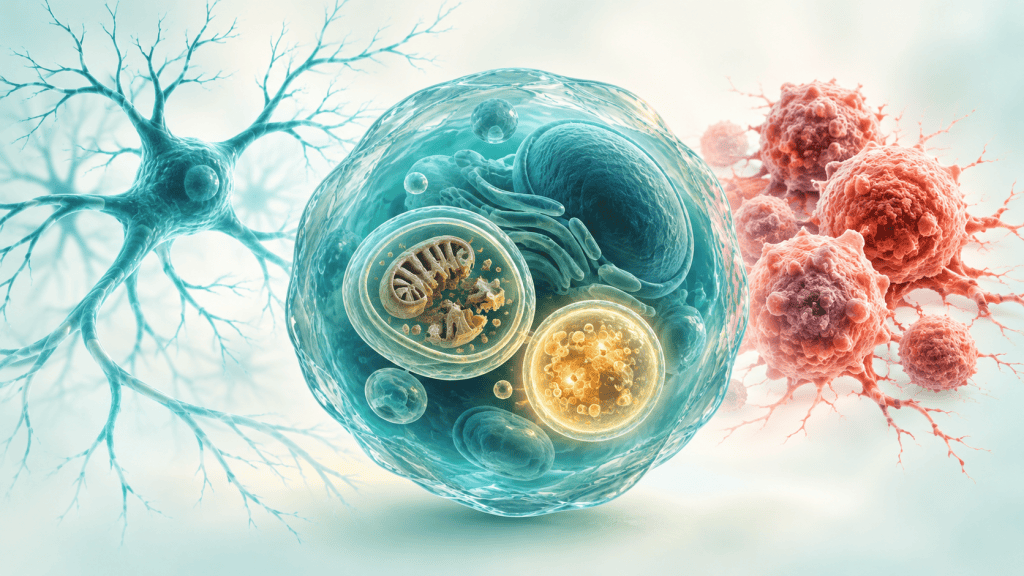
Picture a cell under pressure. Nutrients are running low, and some of its internal parts are damaged. To keep going, it can break down material it no longer needs and recover useful building blocks. This recycling process, called autophagy, helps cells cope with stress. 1
Now picture a cancer cell facing the same shortage. It, too, may use autophagy to stay alive. A process that helps maintain healthy tissue can become a source of support for a growing tumor. 1
That problem sits at the center of a newly finalized review in Pharmacological Reviews by Parul Suri, myself, and our colleagues. We brought together existing research on autophagy in cancer and diseases that damage the nervous system. The review examines how the process is controlled and whether drugs could change it to help patients. It reports no new clinical trial. 1
Following the recycling route
One major form of autophagy begins when a membrane wraps around material inside the cell. The resulting compartment, an autophagosome, carries its contents to a lysosome, where enzymes break them down. The cell can then reuse some of the recovered material. Other forms of autophagy take different routes, and some selectively remove particular damaged parts. 1
Think of this as a collection and processing service. Collecting more bags does not necessarily mean more waste is being processed. The bags might be piling up because the processing facility has stopped working. Similarly, finding more autophagosomes does not, on its own, show that a cell is recycling more effectively. Researchers need to follow what happens to the material through the whole pathway. 1
This distinction matters when testing a drug. A change in one laboratory marker can look encouraging while leaving an important question unanswered: is the cell actually clearing the material? 1
A survival tool that cancer can use
By helping remove damaged components, autophagy can limit changes that contribute to tumor development. But once a tumor is established, the same process can help cancer cells survive shortages of oxygen and nutrients. Experimental studies also show that recycling in nearby normal cells can supply resources to a tumor. The effect depends on the cancer’s biology and its surroundings. 1
It is tempting, then, to suggest shutting the system down. The difficulty is that healthy tissues need it too, and even cancers do not all respond in the same way. The review describes circumstances in which blocking autophagy can have unwanted effects, including promoting the spread of cancer in some experimental models. 1
The challenge is to identify when a tumor depends on autophagy, then find a way to disrupt that dependence without causing unacceptable harm elsewhere. That remains a research goal, rather than a treatment rule that can be applied to every cancer. 1
In the brain, the problem can point the other way
In several neurodegenerative diseases, faulty handling of damaged proteins and cell components is part of the problem. The review discusses proteins such as alpha-synuclein in Parkinson disease and mutant huntingtin in Huntington disease. Here, researchers are investigating whether restoring effective clearance could help protect cells. That rationale does not establish that a drug will slow disease in people. 1
One protein receiving attention is TFEB, which helps control genes involved in autophagy and the production of lysosomes. In the recycling analogy, it helps coordinate the cell’s capacity to collect and process material. But increasing TFEB does not consistently restore clearance in experimental systems. The type of cell, stage of disease, and amount of accumulated material all matter. 1
Nor can researchers assume TFEB should always be blocked in cancer. In a 2019 melanoma study, interfering with the TFEB-controlled recycling response to a cancer drug worsened tumor growth, spread, and drug resistance in experimental systems, including mice carrying implanted tumors. It is a useful reminder that the right treatment direction has to be established for each setting. 2
What happened when the idea reached patients?
Hydroxychloroquine offers a sobering example. Researchers have tested it in cancer because it interferes with lysosomal function and the later stages of autophagy. However, it also affects processes beyond autophagy, making its effects harder to interpret. 1
In a separate phase 2 trial published in 2019, 112 people with previously untreated advanced or metastatic pancreatic cancer were randomly assigned to chemotherapy with or without hydroxychloroquine. Adding the drug did not improve the study’s main outcome: the proportion of patients alive at 12 months. Although tumor responses were more frequent with hydroxychloroquine, the trial did not demonstrate a survival advantage. 3
My interpretation: That result is a reason to be cautious about this particular combination. It does not answer every question about targeting autophagy, because the review describes different targets and disease settings. It does show why a plausible explanation from the laboratory needs to be tested against outcomes that matter to patients. 1, 3
Choosing what the cell removes
Another approach asks whether researchers can guide particular unwanted proteins toward the recycling machinery. The review discusses small molecules designed to do just that. 1
In a 2019 study, researchers identified compounds that could connect mutant huntingtin to LC3, a protein associated with autophagosomes. Some lowered the mutant protein while sparing its normal counterpart, and improved disease-related features in cells, flies, and mice. These were early experimental results, not evidence that the compounds treat Huntington disease in patients. 4
My reading of the evidence: The important question is becoming more precise: which material needs to be removed, in which cells, and at what stage of disease? I draw that interpretation from the review’s repeated emphasis on biological context and from these selective-clearance experiments. The promise is real enough to investigate. Whether a particular approach helps patients still has to be demonstrated. 1, 4
Disclosure: I am a co-first author of the Pharmacological Reviews article discussed here. The additional studies are identified in the references below.
References
- Suri P, Daartey AB, Khan DMIO, et al. Harnessing autophagy and its transcriptional regulation in tumorigenesis and neurodegeneration: Potential and existing therapeutic strategies. Pharmacological Reviews. 2026;78(6):100158. Read the review.
- Li S, Song Y, Quach C, et al. Transcriptional regulation of autophagy-lysosomal function in BRAF-driven melanoma progression and chemoresistance. Nature Communications. 2019;10:1693. Read the study.
- Karasic TB, O’Hara MH, Loaiza-Bonilla A, et al. Effect of gemcitabine and nab-paclitaxel with or without hydroxychloroquine on patients with advanced pancreatic cancer: A phase 2 randomized clinical trial. JAMA Oncology. 2019;5(7):993-998. Read the trial.
- Li Z, Wang C, Wang Z, et al. Allele-selective lowering of mutant HTT protein by HTT-LC3 linker compounds. Nature. 2019;575:203-209. Read the study.
ChatGPT (OpenAI) was used to generate the thumbnail.


Leave a Reply