
Written and edited by Abel B. Daartey, PharmD
- Alcohol is a Group 1 carcinogen and is causally linked to at least 7 cancer types, including breast and colorectal cancer.
- For cancer risk, WHO states that there is no safe level of alcohol consumption. Risk generally rises as intake increases.
- The old idea that alcohol should be used for heart protection is much less convincing now and is not a good reason to start or continue drinking.
For many years, moderate alcohol drinking was sold to the public as something almost healthy. A glass of wine with dinner was framed as harmless, sometimes even protective for the heart.
That message is now much harder to defend. Alcohol may be socially accepted, but biologically it is not neutral. When the conversation is cancer risk, the evidence is clear enough that WHO has said there is no safe level of alcohol consumption [1,2].
This does not mean every person who drinks will get cancer. It means alcohol exposure adds risk, and that risk tends to rise with the amount and frequency of drinking.
How Common Is Alcohol-Attributable Cancer?
The global burden is larger than most people realize. A population-based study in The Lancet Oncology estimated that about 741,300 new cancer cases in 2020, or 4.1% of all new cancer cases globally, were attributable to alcohol consumption [3]. Most alcohol-attributable cases occurred in men, and the leading contributors included esophageal, liver, and breast cancer [3].
Heavy drinking contributes the largest share of harm, but alcohol-related cancers are not limited to heavy drinkers. The same study estimated that moderate drinking contributed more than 100,000 alcohol-attributable cancer cases worldwide in 2020 [3]. This is why public health groups focus not only on alcohol use disorder, but also on routine drinking patterns that many people consider normal.
The Cancer Types Involved
The International Agency for Research on Cancer classifies alcoholic beverages as Group 1 carcinogens, the highest certainty category for cancer hazard. This group also includes tobacco smoke and asbestos, although that does not mean all Group 1 exposures carry the same level of risk [2,6].
Alcohol is causally linked to cancers of the oral cavity, pharynx, larynx, esophagus, liver, colorectum, and female breast [2,4,6]. For breast cancer, even low levels of alcohol intake are associated with increased risk, which is one reason WHO has been very direct about the “no safe level” message [1,5].
A large dose-response meta-analysis covering 572 studies found clear risk increases for several alcohol-related cancers, especially cancers of the oral cavity and pharynx, esophageal squamous cell carcinoma, larynx, colorectum, liver, and female breast [4]. In simple terms, as alcohol exposure rises, cancer risk generally rises too.
How Alcohol Can Cause Cancer
Alcohol causes cancer through several overlapping mechanisms. The most important one begins when the body breaks ethanol down into acetaldehyde. Acetaldehyde is chemically reactive. It can form DNA adducts, interfere with DNA repair, and promote mutations in cells lining the mouth, throat, esophagus, colon, and other tissues [7,8].
Alcohol can also increase oxidative stress through CYP2E1 metabolism, disturb folate handling, change hormone levels, and promote inflammation. In breast tissue, alcohol-related changes in estrogen signaling are one plausible contributor to increased risk [4,5].
There is also a strong interaction with tobacco. In the mouth, throat, and esophagus, alcohol can increase mucosal permeability and make it easier for tobacco carcinogens to reach vulnerable cells. This is one reason people who both smoke and drink have especially high risk for upper aerodigestive tract cancers [6,9].
The Cardiovascular Counterargument
The heart-protection argument is where many people get stuck. Older observational studies often found that light or moderate drinkers had lower rates of some cardiovascular outcomes than nondrinkers. But observational studies are easy to distort here. Some nondrinkers are former drinkers who stopped because of illness. Drinkers and nondrinkers can also differ in income, diet, health care access, social life, and underlying health.
Newer analyses and public health reviews have made the old “drink for your heart” message much weaker. WHO’s position is straightforward: possible benefits seen in some studies do not cancel the cancer risks at the individual level [1,5]. Alcohol should not be started or continued as a health strategy.
Does Quitting Help?
Reducing alcohol does not erase past exposure overnight, but it can reduce future exposure. IARC reviewed alcohol reduction or cessation and found sufficient evidence that reduction or cessation lowers risk for oral cancer and esophageal cancer, with strong mechanistic evidence that stopping alcohol reduces alcohol-related carcinogenic processes such as acetaldehyde exposure, DNA damage, and inflammation-related pathways [6].
For other alcohol-related cancers, the evidence that quitting lowers future risk is still developing, partly because cancer risk can take many years to change and studies are difficult to design [6]. Still, from a prevention standpoint, less alcohol means less exposure to a known carcinogen.
What This Means
The science does not support a safe level of alcohol consumption for cancer prevention. This is not a moral statement. It is a risk statement.
Some people will choose not to drink at all. Some will choose to drink less. Some will continue drinking but should at least know what the biology says. The clearest practical message is simple: if cancer prevention is the priority, less alcohol is safer than more alcohol.
This article is for science education only and is not medical advice. If you are worried about your drinking, have liver disease, are pregnant, take medications that interact with alcohol, or have a cancer history, please speak with a qualified health professional.
References
- World Health Organization Regional Office for Europe. No level of alcohol consumption is safe for our health. 4 Jan 2023. Available at: https://www.who.int/europe/news/item/04-01-2023-no-level-of-alcohol-consumption-is-safe-for-our-health.
- World Health Organization Regional Office for Europe. Alcohol and cancer. 26 Nov 2025. Available at: https://www.who.int/europe/news-room/fact-sheets/item/alcohol-and-cancer.
- Rumgay H et al. (2021) Global burden of cancer in 2020 attributable to alcohol consumption: a population-based study. Lancet Oncol 22:1071-1080. doi:10.1016/S1470-2045(21)00279-5.
- Bagnardi V et al. (2015) Alcohol consumption and site-specific cancer risk: a comprehensive dose-response meta-analysis. Br J Cancer 112:580-593. doi:10.1038/bjc.2014.579.
- Anderson BO et al. (2023) Health and cancer risks associated with low levels of alcohol consumption. Lancet Public Health 8:e6-e7. doi:10.1016/S2468-2667(22)00317-6.
- Gapstur SM et al. (2023) The IARC perspective on alcohol reduction or cessation and cancer risk. N Engl J Med 389:2486-2494. doi:10.1056/NEJMsr2306723.
- Mizumoto A et al. (2017) Molecular mechanisms of acetaldehyde-mediated carcinogenesis in squamous epithelium. Int J Mol Sci 18:1943. doi:10.3390/ijms18091943.
- Brooks PJ and Zakhari S (2014) Acetaldehyde and the genome: beyond nuclear DNA adducts and carcinogenesis. Environ Mol Mutagen 55:77-91. doi:10.1002/em.21824.
- Chamoli A et al. (2021) Overview of oral cavity squamous cell carcinoma: risk factors, mechanisms, and diagnostics. Oral Oncol 121:105451. doi:10.1016/j.oraloncology.2021.105451.
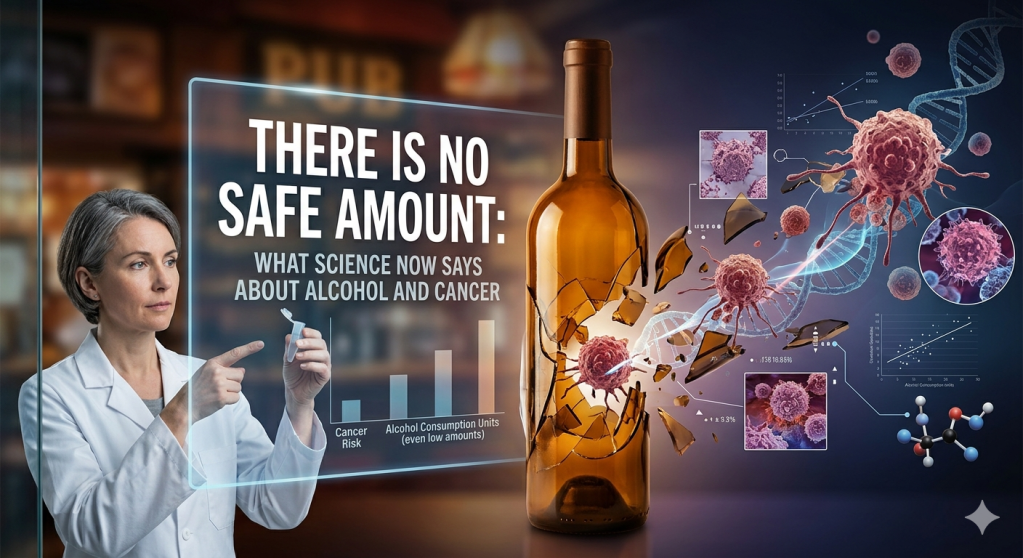
Featured image created using Google Gemini AI.


 BreathPharma
Leave a comment