Written and edited by Abel B. Daartey, PharmD
- Your DNA sequence is mostly fixed, but the way your cells read DNA can change through epigenetic marks.
- Food, sleep, stress, smoking, inflammation, and some environmental exposures can influence gene activity, but not everything is under personal control.
- Epigenetic clocks are useful research tools for biological aging. They are not destiny tests, and they should not be used to blame people for disease.
Your DNA is the instruction manual you are born with. The letters in that manual usually do not change much during life. But cells still need a way to decide which instructions to use, when to use them, and how strongly to use them. That second layer of control is called epigenetics.
A simple way to think about it is this: genes are the words, and epigenetics is the highlighting, bookmarks, and sticky notes. These marks do not rewrite the DNA letters. They help decide whether a gene is easy or difficult for the cell to read [1]. That matters in cancer because cancer is not only a disease of DNA mutations. It is also a disease of gene-control systems going off balance.
What Epigenetics Means
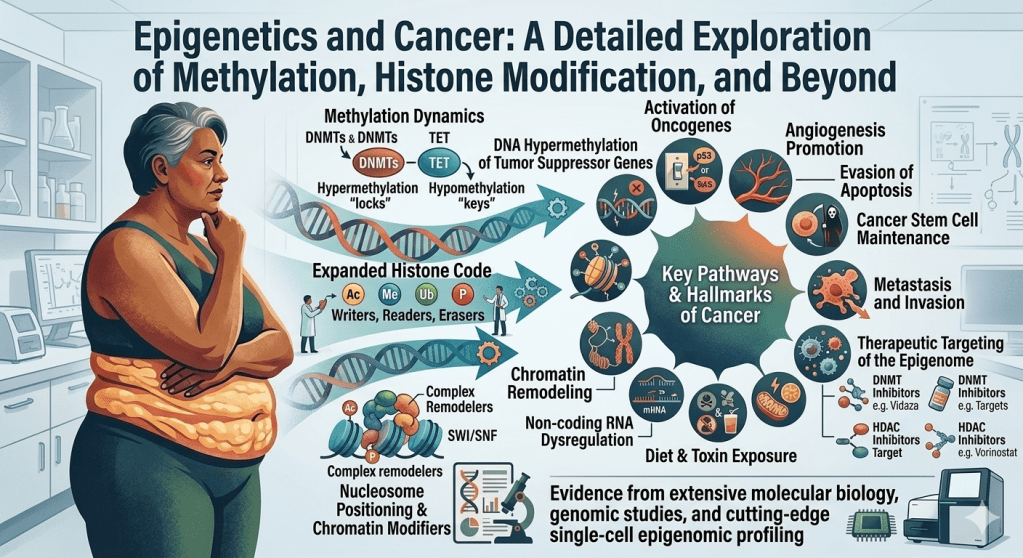
Cells control genes in several ways. DNA methylation adds small chemical tags to DNA, often making a gene harder to read. Histone modifications change the proteins that DNA wraps around, loosening or tightening the DNA package. Small RNA molecules can also fine-tune how much of a message gets made [1,2].
In cancer, these controls can become distorted. Tumor suppressor genes, which normally act like brakes, may be silenced by abnormal methylation. Other areas of the genome may lose normal methylation, making chromosomes less stable. This is one reason two tumors with similar mutations can behave differently [3,4].
Diet and Metabolism Can Feed the System
Epigenetic enzymes need chemical building blocks. Methylation depends partly on nutrients and metabolism that help produce SAM, a methyl donor. Histone acetylation is linked to acetyl-CoA, a central metabolic molecule made from carbohydrates, fats, and proteins [2]. This is why diet and metabolism can influence gene regulation.
But this should be stated carefully. Eating one food will not “turn cancer genes off” in a simple way. The effect depends on dose, timing, tissue type, gut metabolism, genetics, health state, and the rest of a person’s environment. Nutrition matters, but it is not a magic switch.
Plant Compounds and Epigenetic Signaling
Some plant compounds, including sulforaphane from broccoli, resveratrol from grapes, curcumin from turmeric, and EGCG from green tea, can affect epigenetic enzymes in laboratory studies. Many of these findings are interesting because they connect food chemistry to pathways such as DNA methylation, histone acetylation, inflammation, and oxidative stress.
The limitation is translation. Cells in a dish are exposed to controlled concentrations. A human body digests, modifies, and clears these compounds. So it is fair to say these compounds are biologically active. It is not fair to say they are proven cancer treatments.
The Epigenetic Clock
One of the most visible discoveries in this field is the epigenetic clock. In 2013, Steve Horvath described a DNA methylation clock that could estimate age across many tissues by reading methylation at specific sites in the genome [5]. Later models, including DNAm PhenoAge, tried to connect methylation patterns with healthspan, mortality, and disease risk [6].
This is scientifically powerful, but readers should not overinterpret it. Biological age tests can be useful in research, and they may become more clinically helpful over time. For now, they are not a crystal ball. A higher epigenetic age does not mean someone will definitely get cancer, and a lower number does not remove the need for screening, exercise, healthy eating, vaccination, and medical care.
Can Epigenetic Marks Be Passed On?
Animal studies show that some environmental exposures can leave epigenetic effects across generations [7]. Human evidence is more complicated. Famines, smoking, stress, endocrine disruptors, and early-life exposures have all been studied, but proving true transgenerational inheritance in humans is difficult because families also share culture, diet, income, neighborhood, trauma, and health care access.
So the careful conclusion is this: early-life and parental environments can matter, and epigenetics may be one mechanism. But we should avoid turning that into blame. Biology is shaped by both choices and circumstances.
Clinical Epigenetics
Epigenetics is already part of cancer treatment. Drugs that affect DNA methylation, such as azacitidine and decitabine, are used mainly in blood cancers. HDAC inhibitors, including vorinostat and romidepsin, are also used in selected blood cancers [4,8]. These drugs show that the epigenome can be a real treatment target.
The EZH2 story is more cautious. Tazemetostat received accelerated FDA approval in 2020 for certain patients with follicular lymphoma and epithelioid sarcoma [9]. But in 2026, FDA alerted clinicians and patients that the sponsor would voluntarily withdraw Tazverik from the U.S. market because of an increased rate of hematologic second primary malignancies, meaning new blood cancers in treated patients [10].
That update does not erase the promise of epigenetic therapy. It shows why long-term safety matters. When we target gene-control systems, the biology can be powerful, but it can also have delayed consequences.
The Bottom Line
Your lifestyle can influence gene activity, but it does not write your entire fate. Epigenetics gives us a more realistic picture: genes, environment, aging, metabolism, and social conditions all interact. For cancer prevention, that means the same boring advice still matters: avoid tobacco, limit alcohol, keep a healthy weight when possible, move your body, sleep regularly, vaccinate against HPV and hepatitis B when appropriate, and follow evidence-based screening.
This article is for educational purposes only and should not be used as personal medical advice. Anyone with cancer or a high inherited cancer risk should discuss prevention, screening, and treatment with a qualified health care professional.
References
- Feinberg AP. The key role of epigenetics in human disease prevention and mitigation. N Engl J Med. 2018;378:1323-1334. doi:10.1056/NEJMra1402513.
- Zhang Y and Kutateladze TG. Diet and the epigenome. Nat Commun. 2018;9:3375. doi:10.1038/s41467-018-05778-1.
- Baylin SB and Jones PA. A decade of exploring the cancer epigenome. Nat Rev Cancer. 2011;11:726-734. doi:10.1038/nrc3130.
- Dawson MA and Kouzarides T. Cancer epigenetics: from mechanism to therapy. Cell. 2012;150:12-27. doi:10.1016/j.cell.2012.06.013.
- Horvath S. DNA methylation age of human tissues and cell types. Genome Biol. 2013;14:R115. doi:10.1186/gb-2013-14-10-r115.
- Levine ME et al. An epigenetic biomarker of aging for lifespan and healthspan. Aging. 2018;10:573-591. doi:10.18632/aging.101414.
- Skinner MK et al. Epigenetic transgenerational actions of environmental factors in disease etiology. Trends Endocrinol Metab. 2010;21:214-222. doi:10.1016/j.tem.2009.12.007.
- National Cancer Institute. Azacitidine and related cancer drug information.
- U.S. Food and Drug Administration. FDA granted accelerated approval to tazemetostat for follicular lymphoma. 2020.
- U.S. Food and Drug Administration. FDA alert on increased risk of new blood cancers with Tazverik and sponsor withdrawal. 2026.
Featured image created using Google Gemini AI.


Leave a Reply