
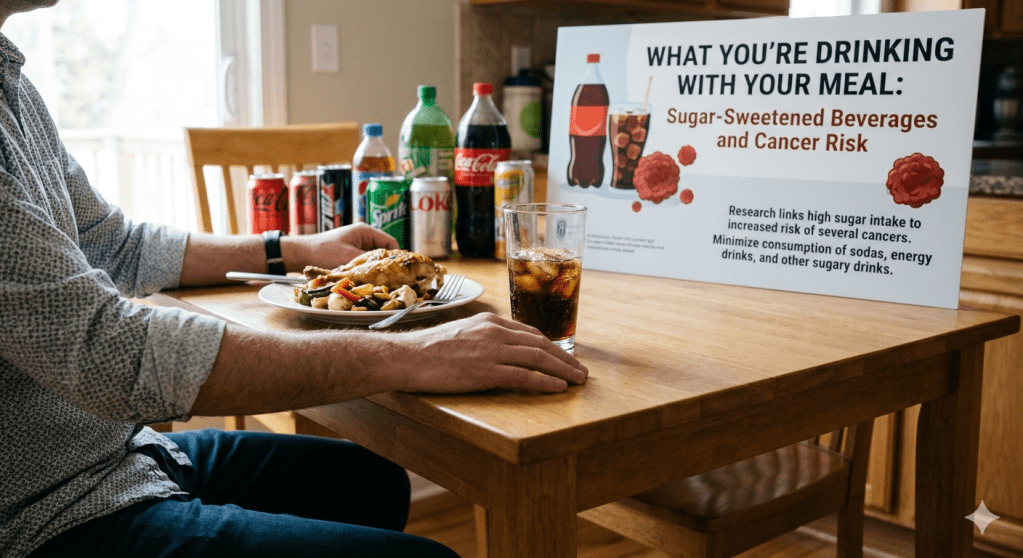
- Sugary drinks (sodas, sweetened juices and teas, sports drinks) raise cancer risk mainly by driving weight gain, which is linked to at least 13 cancers.
- Large studies tie more sugary drinks to higher risk of breast cancer and of bowel cancer in younger adults — even after accounting for body weight.
- Switching to “diet” drinks is not clearly safe either; the simplest helpful change is to cut back on sweet drinks overall.
Sugar-sweetened beverages (SSBs) — carbonated soft drinks, fruit-flavoured drinks, sweetened teas, and sports drinks — account for a substantial proportion of added sugar intake in many populations. Their role in obesity and metabolic syndrome is well-established. Less discussed, but increasingly well-supported by epidemiological and mechanistic evidence, is their association with cancer risk.
The Obesity Pathway: A Recognised Link
The most direct pathway connecting SSBs to cancer risk runs through body fat. The World Cancer Research Fund (WCRF) has identified excess body fatness as a cause of at least 13 cancers, including colorectal, endometrial, post-menopausal breast, liver, pancreatic, kidney, and oesophageal cancer. An IARC Working Group reviewed the evidence and concluded it was strong enough to call this a causal relationship [1]. Sugary drinks, as a major source of extra calories and belly fat, sit early in this chain.
Fat stored around the organs is not inert — it is biologically active. It releases hormones (such as leptin and adiponectin) that affect how the body handles insulin and inflammation. Together, high leptin, low adiponectin, and steady low-grade inflammation create an internal environment that makes it easier for tumours to start and grow.
Insulin, IGF-1, and Tumour Biology
Sugary drinks spike blood sugar quickly. Over time, diets high in fast-absorbing sugar push up insulin and a related growth hormone called IGF-1. A meta-analysis in Diabetes Care found that SSB consumption was significantly linked to metabolic syndrome and type 2 diabetes — conditions marked by chronically high insulin and IGF-1, which in turn switch on growth signals (the PI3K/Akt/mTOR pathway) that help cancer cells survive and multiply [2].
This matters especially for bowel (colorectal) cancer. A prospective cohort analysis found that higher SSB consumption was significantly associated with increased risk of early-onset colorectal cancer — cancer diagnosed before age 50 — with people in the highest intake group at about 1.5 times the risk of those in the lowest [3]. Early-onset bowel cancer has risen sharply over the past two decades, and sugary-drink intake is one of the most plausible contributing factors. Adding to this, the NutriNet-Santé cohort found that each extra 100 mL per day of sugary drinks was linked to an 18% higher overall cancer risk and a 22% higher breast cancer risk — even after accounting for body weight, hinting at effects beyond body fat alone [4].
Artificial Sweeteners: A Separate Concern
One common response to the harms of sugary drinks is to switch to artificially sweetened “diet” drinks. That swap is not automatically harmless. Several artificial sweeteners — particularly saccharin, aspartame, and sucralose — can shift the balance of gut bacteria, reducing helpful species such as Lactobacillus and Bifidobacterium and weakening the gut lining [5]. Whether these changes meaningfully affect cancer risk is not yet settled, but the link between gut bacteria and cancer is an active research area, because gut microbes influence inflammation, the immune system, and how the body handles potential carcinogens.
Fructose and the Liver
Drinks sweetened with high-fructose corn syrup (HFCS) put a particular load on the liver. Unlike other sugars, fructose is processed almost entirely in the liver, where it is readily turned into fat. This can drive non-alcoholic fatty liver disease (NAFLD), even apart from total calories [6]. When fatty liver progresses to inflammation and scarring (NASH and cirrhosis), the risk of liver cancer rises — cirrhosis from this cause carries roughly a 1–2% annual risk of liver cancer, building up over years [7]. Fructose also raises uric acid, which can stiffen blood vessels and add to the metabolic strain.
The Paediatric Dimension
Drink habits form early. Childhood and teenage intake of sugary drinks predicts adult metabolic risk, and early-life diet can have very long-delayed links to adult cancer. In other words, this is not only a problem of adult overindulgence — it is a childhood exposure whose full cancer impact may not show up in the statistics for another generation.
The Evidence, Summarised
No single drink causes cancer on its own. But taken together — the population studies, the metabolic biology, and the gut-bacteria evidence — sugary drinks emerge as a changeable contributor to cancer risk, especially for bowel, liver, and hormone-sensitive cancers. Cutting back on them is one of the easiest dietary changes to make, and it pays off for heart and metabolic health at the same time.
References
- Lauby-Secretan B et al. (2016) Body fatness and cancer. N Engl J Med 375:794–798.
- Malik VS et al. (2010) Sugar-sweetened beverages and risk of metabolic syndrome and type 2 diabetes. Diabetes Care 33:2477–2483.
- Hua X et al. (2023) Sugar-sweetened beverage consumption and early-onset colorectal cancer risk. Front Oncol 13:1132306.
- Chazelas E et al. (2019) Sugary drink consumption and risk of cancer: NutriNet-Santé cohort. BMJ 366:l2408.
- Meenatchi P and Vellapandian C (2024) Artificial sweeteners, gut microbiota disruption, and cancer risk pathways. Cureus 16:e70043.
- Stanhope KL (2016) Sugar consumption, metabolic disease and obesity. Crit Rev Clin Lab Sci 53:52–67.
- Loomba R and Sanyal AJ (2013) The global NAFLD epidemic. Nat Rev Gastroenterol Hepatol 10:686–690.
Featured image created using Google Gemini AI.


 BreathPharma
Leave a comment